

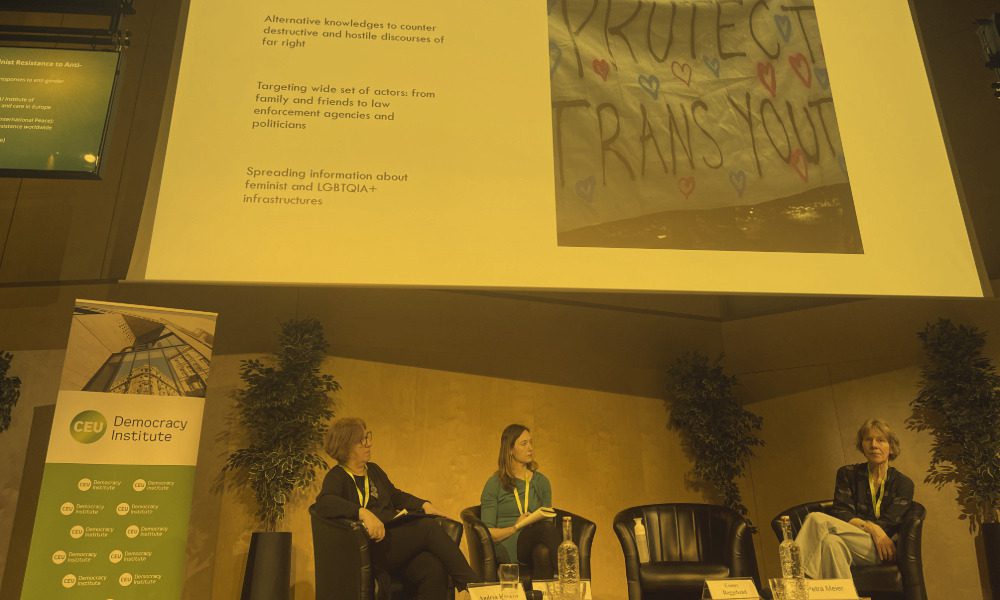
Last week, on 20 March 2026, Athena Forum attended the “Feminist Futures Workshop: Feminist Responses to Anti-Democratic Politics” in Budapest. The event formed part of the Horizon Europe project CCINDLE (with a budget of over €2.5 million), which examines what it defines as “anti-gender mobilisations” in Europe.
The choice of Budapest, according to the organisers, was symbolic, coming ahead of Hungary’s upcoming elections. The venue, the Central European University (CEU), also carries particular significance in the region. Founded in the early 1990s with funding from George Soros, it was established as a flagship liberal academic institution in post-socialist Eastern Europe, positioning itself as a centre for critical thought, democracy, and open society values. Over the years, it has produced a generation of scholars, many of whom have moved into politics, including national parliaments and European institutions.
Over time, the CEU has become strongly associated with a particular strand of liberal thought, most visibly in gender studies, which has shifted away from the analysis of material realities towards post-material theories increasingly detached from them. This approach was clearly reflected in the event itself, as well as in the broader CCINDLE project.
Following legislative changes introduced by the Hungarian government in 2017 targeting foreign-accredited universities, the CEU was effectively forced to relocate most of its operations to Vienna by 2019, while maintaining a limited presence in Budapest. Today, its Vienna campus reflects its continued status as a well-funded international institution, both physically and intellectually removed from the national context in which it was originally established.
The event itself brought together primarily the project’s academic partners, alongside a number of politicians and activists, all drawn from broadly the same political spectrum (Left/Greens) and firmly positioned on the same side of the debate, resulting in a strikingly homogeneous perspective.
The ‘anti-gender’ as a tool to silence feminists
During the event, a sense of alarm around “anti-gender” as a major threat to democracy dominated the presentations. Originally emerging from religious opposition, the term has since been taken up wholesale by “progressive” academics and expanded to encompass anyone critical of how “gender” is currently used in policy and law.
According to the project’s rationale, “anti-gender politics” constitutes a core component of contemporary autocratisation projects. As a result, anyone questioning “gender” is amalgamated into a single, supposedly well-funded “anti-gender” movement. Any actor whatsoever, be it the Trump administration in the United States, the Vatican’s anti-abortion positions, a gender-critical anti-fascist feminist imprisoned under Franco in Spain or a young lesbian regretting her “gender transition”, is brought under this label and presented as part of a powerful political force eager to strip European citizens of their democratic liberties.
Other loaded and never properly defined or examined terms, including “fascism”, “hatred” and “denial of the right to exist” were thrown around by presenters as rhetorical props to amplify the dramatic effect of “anti-gender”. After all, dramatic effect is what the event required to compensate for its remarkably shallow presentations that neither provided any concrete evidence, nor attempted to disaggregate or analyse the actors lumped together as the “anti-gender” movement.
In this constellation of supposed “anti-democratic” forces, women’s rights defenders were the ones most clearly silenced. Once the defence of sex-based rights is placed under the same label as extremism, it is dismissed before it is even heard, and this dismissal is not only apparent in the materials delivered by the project — mappings, reports and academic articles that the project has produced in abundance — but it was palpable in the room.
Despite taking place in Hungary, not a single Hungarian women’s rights organisation was invited to speak. The project presents itself as “co-creation” — the very meaning of the “CC” in its acronym — yet Hungarian feminists with decades of grassroots experience in women’s rights were present only as objects of research, not as co-creators. Their role was reduced to being studied, categorised and displayed, producing a familiar transactivist dynamic: a patronising, top-down approach that speaks about women, on behalf of women, while keeping them out of the conversation, using the label of “anti-gender” as a tool to do so.
The few opportunities offered to Hungarian women’s rights organisations, such as displaying materials in the hall, felt more like decoration than participation. Other women’s rights organisations, including the Swedish Women’s Lobby, were mentioned dismissively by presenters as holding an “anti-trans” position, without any explanation as to how the defence of women’s rights constitutes being “anti” to anything.
The ‘right’ type of feminism
As a result, feminist activists who rely on long-established legal and policy frameworks — sex-based protections, single-sex spaces clearly permitted under EU law, and measures to address structural inequality between women and men — were not only entirely absent from the discussion, but were recast as opposing democracy and human rights.
Instead, the audience was presented with a dogmatic worldview, according to which the only “right” type of feminism is one that opens the legal category of “woman” to any man who identifies as such, erases lesbians out of legal existence, and allows for unrestricted self-ID for all. This stands in direct contradiction to EU legal standards, where sex remains a core protected category underpinning equality law and policy.
Yet this contradiction did not present a moral, intellectual or legal dilemma for the speakers. Academic analysis — and perhaps even the reading of EU legal instruments — did not appear to be conceived by the project leaders as an essential task of researchers under a Horizon project, funded by EU taxpayers and aimed at informing EU policymakers.
This extraordinarily poor-quality approach to research, in which some of the deliverables appear to have been written by ChatGPT, resulting in the mischaracterisation, misnaming and even mis-sexing of those accused of “anti-gender” positions, is what informed the presenters’ “analysis” of feminism and its supposed “strategies” to resist whatever it is the project authors believe feminists should resist.
Among those to be resisted is a significant part of the feminist movement itself — namely those not prepared to sacrifice women’s rights at the altar of postmodernist theories that seek to do away with the basis of discrimination against women through linguistic acrobatics that redefine the material reality in which women and girls suffer the material consequences of this discrimination.
Instead of documenting what is by now a vast track record of intimidation, harassment, censorship and actual violence directed at so-called gender-critical feminists across multiple locations in Europe, the presenters not only failed to acknowledge that such violence exists, but instead positioned the women resisting it as an ultimate threat to democracy. Rather than recognising these feminists as targets of anti-democratic extremist activists, who will go to great lengths to silence and smear women’s rights defenders in order to protect their worldview, in which self-declared identities obliterate others’ lived realities, the speakers maintained that the clash of rights between those individuals who identify as transgender and the female sex is a conspiracy theory fabricated in the dark corridors of religious fundamentalism.
“Intersectionality” and “inclusion” were presented as viable solutions to a conflict that, according to the presenters, does not exist in the first place, while “care” was framed as a strategy for women to cope with the hostilities they face.
In other words, once again, a group of elite academics from Western Europe, disconnected from the realities of most people not only across Europe but globally, told women to “be nice” — or be labelled fascist-adjacent.
The end of ‘no-debate’ in EU-funded projects
Despite the event being remarkably unimpressive, both in content and format, it was an important opportunity for Athena to attend. Through several interventions from the floor, we made our presence and our positions known, which, despite the uncomfortable silence from the panellists, led to productive exchanges with many attendees who were genuinely interested in the perspective so markedly suppressed in the presenters’ speeches.
Hungarian feminists also challenged the room directly, raising important questions about how the organisers define “progress”, when legislative proposals hailed as “progressive” — from legalising pimping in Romania to egg donation in Hungary — have harmful consequences for women and girls.
The question of clarity in language, policy and law, which did not receive an answer from the panellists beyond defining progress as the inclusion of all in everything, was left hanging in the air as the event came to a close. What became apparent by the end of the conference was that those in receipt of substantial EU funding, expected to meet high standards of rigorous research, impartiality and compliance with the EU’s foundational value of non-discrimination on the basis of sex, are, at best unfamiliar with the fundamentals of European law and policy, and at worst, unwilling to carry out their academic responsibilities.
In either case, the implicit “no-debate” policy taken for granted by the researchers of the CCINDLE project was, if only momentarily, broken — a democratic principle that Horizon-funded academics may find uncomfortable, but are ultimately bound by law to respect.