
© European Union, 2026, licensed under CC BY 4.0
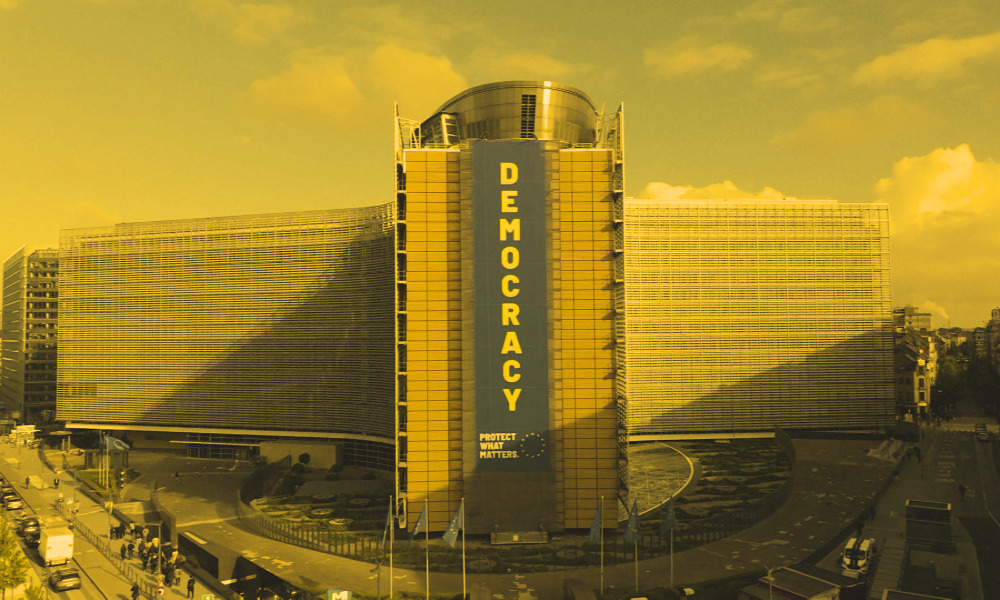
On 9 May, Europe Day, institutions across Brussels celebrated the European Union as a project built on democracy, pluralism, human rights and the rule of law. These values are repeatedly invoked as Europe’s defining moral and political foundation, but they only matter if political questions can actually be debated, if policymakers understand the laws they are shaping, and if citizens are able to challenge harmful proposals without fear of reputational destruction.
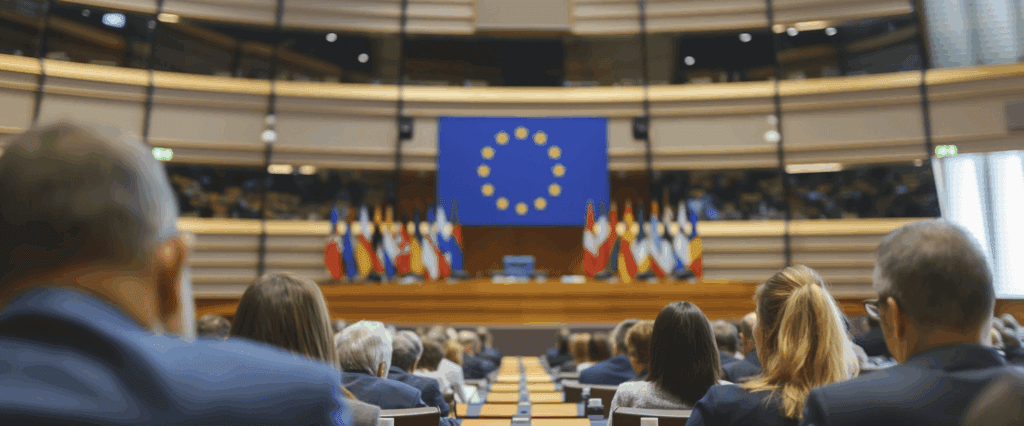
Last week, we travelled to Brussels for a series of advocacy meetings with Members of the European Parliament across political groups, alongside discussions with civil society actors and women’s organisations, including the European Women’s Lobby.
The purpose of the visit was to bring a set of concerns into institutional discussions that have, for too long, been treated not as legitimate political questions but as subjects to be avoided altogether. During our meetings, we sought to draw attention to three key issues:
- the erasure of sex from law and policy, and its replacement with gender identity and expression through self-identification frameworks;
- the conflation of sexual orientation with gender identity in legislation and public discourse, particularly through recently proposed conversion therapy bans;
- the increasing use of hate speech and hate crime frameworks to shut down democratic disagreement around contested concepts.
Political paralysis with costs for EU citizens
What emerged from our meetings with MEPs was revealing. Across political groups, most parliamentarians acknowledged that these issues are deeply contested. Many recognised that the current climate inside the European Parliament, including in the Committee on Women’s Rights (FEMM), has become so polarised around questions of sex, gender identity and related concepts such as gender mainstreaming that meaningful debate is all but impossible.
Our discussions also made clear that too many lack the knowledge expected of European lawmakers, not only on the subject matter itself, but also on the views of stakeholders whose lives are directly affected by these debates, including feminist organisations, lesbian and gay activists, parents and health experts.
However, this lack of understanding was ultimately overshadowed by one dominant theme: fear.
Fear of public association with the “far right.” Fear of reputational attacks. Fear of losing political alliances. Fear of becoming the next target of intra-parliamentary investigations for allegedly violating house rules or hate speech regulations, with the risk of sanctions, limitations on one’s mandate and institutional exclusion.
As a result, many MEPs who may privately hold concerns, or even opposing views, remain publicly silent. Their political positioning becomes reactive, shaped less by what they believe than by what they wish not to be seen as or associated with. In practice, this means that European Parliament voting on important legislative instruments is driven not by engagement with their substance, but by the distance MEPs believe they must maintain from certain political groups.
Consequently, legislation touching on gender identity-related issues is rarely debated on its merits, but instead as part of a wider symbolic struggle against perceived political opponents.
The implications of such an approach to law-making are clear: where EU citizens would expect the greatest scrutiny from their MEPs, laws, regulations and resolutions are often passed with the least inquiry and the most performance. In one recent example of such performative policy-making, during the plenary debate on a “conversion therapy ban”, prompted by a European Citizens’ Initiative, MEP Irmhild Boßdorf (ESN) is now being subjected to a hate speech investigation after questioning the role of lobby groups in promoting the gender identity agenda within the Parliament. This followed an intervention by German MEP Lukas Sieper (Renew), who called on the President of the Parliament to intervene under the rules on hate speech, referring to her remarks as crossing the boundaries of acceptable discourse.
Conformity vs extremism
When decision-making within the EU’s only directly elected legislative body is driven by fear and a lack of evidence, it reflects neither a healthy democratic culture nor serious policymaking.
European law has historically been built around the clear protected characteristics of sex and sexual orientation. In recent years, however, terms such as “queer”, “gender expression” and (LGBTIQ) “plus” have entered key areas of EU policy, with far-reaching and often damaging effects across a range of human rights. This includes the rights of those these terms claim to represent, namely lesbians and gay men, as well as individuals experiencing discomfort with or dissociation from their biological sex.
The uncritical acceptance of this terminology has become possible for several reasons, not least due to the prominence of the European Parliament’s so-called LGBTIQ+ Intergroup — the largest and most influential cross-party grouping of MEPs, spanning nearly all political families, including the conservative and centre-right EPP (European People’s Party).
This acceptance has also been enabled by the vacuum created through the deliberate exclusion of progressive actors with the knowledge, expertise and willingness to scrutinise both the meaning and the impact of these terms.
Instead, organisations such as the European Parliamentary Forum for Sexual and Reproductive Rights (EPF) — an NGO that presents itself as a high-level political stakeholder and enjoys extensive access to MEPs and their assistants, and which has in the past been chaired by a well-known Belgian trans-identified politician — have come to dominate the parliamentary landscape. They provide guidance to MEPs who can hardly distinguish between sexual orientation and gender identity.
As a result, in the absence of visible civil society organisations within EU institutional spaces that critically engage with terms and policies aggressively advanced by gender identity lobby groups, the only politically “safe” position for many MEPs has become the full acceptance of an entire set of demands.
This means accepting the replacement of sex with gender identity in law and policy; accepting the erosion of women-only spaces and sex-based exemptions; accepting the weakening of safeguarding frameworks around children; and accepting the redefinition of sexual orientation through a gender identity lens.
Any attempt to question even part of this agenda risks immediate reputational consequences which, ironically, within the European Parliament, appear to affect not only the Left and Liberals, but also the Right. Whereas the former risk being accused of aligning with the Right, the latter are accused of extremism. In other words, when it comes to sex and gender, across the political spectrum there is always something worse to fear being portrayed as.
This tactic of silencing debate is reported to be effective: some MEPs would walk out of the chamber during voting, others abstain, and some feel compelled to support formulations and texts which, in a serious legislative context, would not withstand even superficial scrutiny.
A path to political courage and legal clarity
Our meetings with MEPs confirmed what we had already observed: gender identity lobby groups have dominated the European Parliament over several recent terms, resulting in a proliferation of legally incoherent texts. On the one hand, the Parliament calls for the collection of sex-disaggregated data; on the other, it repeatedly invokes the Yogyakarta +10 principles, which call for the elimination of such data altogether.
What was particularly revealing in our discussions with MEPs was their limited awareness of the range of actors — including specialists in women’s rights, LGB issues, as well as the education and health sectors — who not only question the wholesale acceptance of harmful transactivist demands in key areas of EU fundamental rights, such as human dignity, privacy, freedom of association and expression, equality and non-discrimination, but whose objections are grounded in substantial research, evidence, decades of analysis and practical experience.
That such actors exist across most EU Member States, and continue their work in often hostile environments without backing from corporate or state donors, is well known to anyone engaged in the so-called “gender wars” on either side. It is recognised by gender-critical feminists and lesbian and gay activists, and equally by those lobbyists who prefer to deny the existence of such opposition within civil society or, when it cannot be ignored, to attribute it to the influence of evangelical funders.
For several MEPs, meeting Athena Forum appeared to be both surprising and, at times, disarming. Many seemed genuinely unaccustomed to encountering these arguments outside the dominant institutional narratives through which gender identity policies are typically presented and accepted. Our discussions offered moments of reflection, not only on the substance of the issues themselves, but also on the tactics used against organisations raising critical concerns, including smear campaigns conducted through activist research and advocacy funded by European institutions and programmes.
The road ahead is undoubtedly long, and change within European institutions rarely comes quickly. But every political shift begins with a first breach in enforced consensus, and this is what Athena’s visit to the European Parliament helped to achieve. Once debate re-enters the room, facts, material reality and both the intended and unintended consequences of law and policy will, in time, assert themselves in public view, however long they may be suppressed or concealed. We are determined to play a leading role in this process.