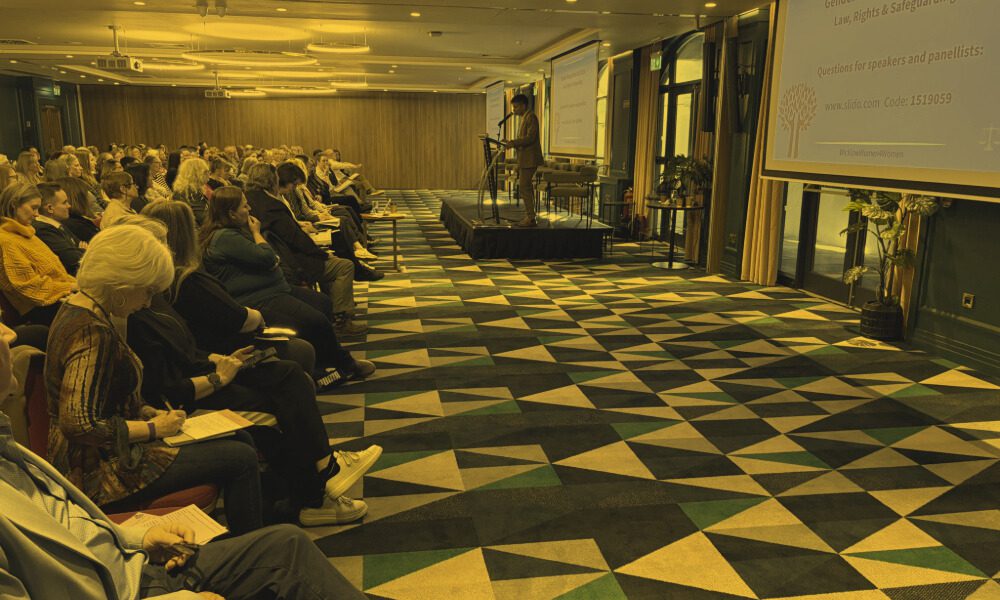
This article was originally delivered by our director Faika El-Nagashi during the opening session of the conference Gender Recognition Act 2015: Law, Rights and Safeguarding (7 March 2026, Dublin), organised by Wicklow Women for Women.
In a few months, on July 1st, Ireland will take over the rotating presidency of the Council of the European Union, also referred to as the presidency of the EU. This last happened 13 and a half years ago and will happen again in roughly that time. The presidency lasts for six months.
During that time you can expect a lot of very important high-level meetings, very busy side events and a very enthusiastic celebration of European values and democracy – which will include “efforts to promote and protect LGBTIQ+ rights”.
I am not saying this based on my assumptions, but on the National LGBTIQ+ Inclusion Strategy II – Action Plan 2025–2026 of the Government of Ireland.
One of its strategic objectives, placed under Pillar 4 (Equality and Non-Discrimination), is to advance the protection and promotion of LGBTIQ+ rights at an international level. This includes the UN, the EU, the Council of Europe, the OECD and the OSCE; embassy networks, outreach and funding initiatives, and specifically: the EU’s LGBTIQ+ Equality Strategy, and the Irish EU presidency.
You can also find this in Ireland’s Programme for Government, with the explicit commitment to “engage in discussions at key international forums, including the EU and the UN, to uphold the universal nature of human rights, ensuring that these rights apply equally to all individuals, regardless of gender identity, sexual orientation, or any other characteristic”.
The Irish LGBTIQ+ agenda is not only an expanding one, but also a pioneering one. In recent years we have seen the development of a coordinated European agenda in which Ireland plays a leading role and helps shape and export policies across European institutions. Irish politicians, activists and activist-politicians have been instrumental in pushing for transactivist policies in international institutions, and in driving the shift towards a gender identity focus within the EU. From Mary Robinson to Michael O’Flaherty, Maria Walsh to Leo Varadkar.
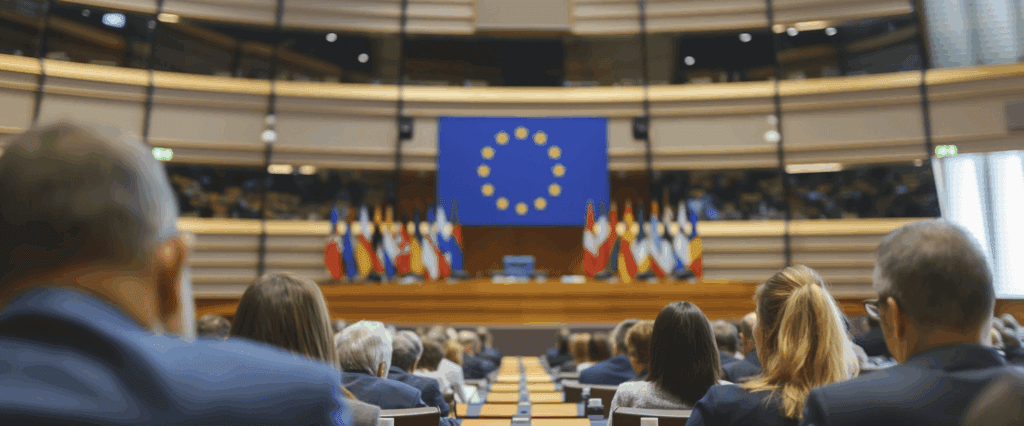
At the recent European Parliament vote, 12 of the 14 Irish MEPs supported the call to emphasise the importance of the recognition of trans identified men as women. This included Irish members of the European political groups of the Left, the Socialists and Democrats, and the Liberals, as well as the biggest and most influential group in the European Parliament: the European People’s Party and Christian Democrats, or EPP, a group “driven by a centre-right political vision”, of which Fine Gael is a founding member.
When it comes to gender identity, the EPP has become an immovable object. If anything, it is turning into an unstoppable force.
Last year, the LGBTIQ+ network within the EPP changed its name to EPPride. It is an associated entity within the EPP, with Fine Gael as one of its ten members. EPPride participated in the creation of the EPP election manifesto, cooperates with the EPP’s think tank, and gives workshops on “Strengthening the LGBT+ voice as part of the centre-right narrative”.
Meanwhile, Fianna Fáil, part of the European liberal Renew group, contributes its part; and both parties join forces in their relentless push to make Ireland best in class and to ease the burden of the collective failings of the past.
They talk to EU commissioners, lobby the committees and the European Parliament, and have repeatedly made their priorities clear:
- expansion of self-ID regulations to include minors and to create a legal non-binary category
- comprehensive bans on conversion therapy: a proposal from 2018 in Ireland went so far as to include a global jurisdiction clause concerning Irish citizens abroad
- “the need to ensure equal recognition for families under Irish law”, which is code for surrogacy legalisation nationally and internationally
- and hate speech and hate crime laws.
All of this comes with continued “international advocacy”, which is now aided by former Taoiseach Leo Varadkar, who holds a position as Senior Fellow in the Global LGBTQI+ Human Rights Program at Harvard Kennedy School, leading a project titled „The Future of LGBTQI+ Rights in the European Union“.
Here, the transactivist demands transform into policy language and emerge shapeshifted as equality, citizenship, democracy, the rule of law, non-discrimination, inclusion and values. For this, Varadkar will devise “a baseline of rights and protections that every EU member state should aspire to” and will be meeting stakeholders across Europe – equipped with connections, influence, reputation and resources.
In this framing, there are three aspects to particularly look out for:
- burying women’s rights and violence against women in a linguistic and conceptual fog of gender and gender-based violence
- a focus on sexual and reproductive health and rights as a policy field, advancing the interests of a male sexual rights movement that disguises the exploitation of women through surrogacy as “equality for rainbow families”
- centring the debate around values and human dignity, using this framing to mobilise programmes, campaigns and resources, while expanding the scope of regulation into areas of justice and rule of law, shifting the issue away from women’s rights and presenting it instead as a priority concern of democracy
Under the banner of “human rights”, high-profile and heavily resourced stakeholders are advancing the interests of a sexual rights industry that profits from the sexual and reproductive exploitation of women while erasing women as a political and legal category altogether.
Ireland wants the driver’s seat when it comes to shaping this future of human rights. In August 2028, Europe will “follow the Rainbow” to Ireland for EuroPride.
This may all look grim. And it is. But it is important to understand what we are up against, and to know when, where and why we draw a line.