

(c) Helsingin Sanomat
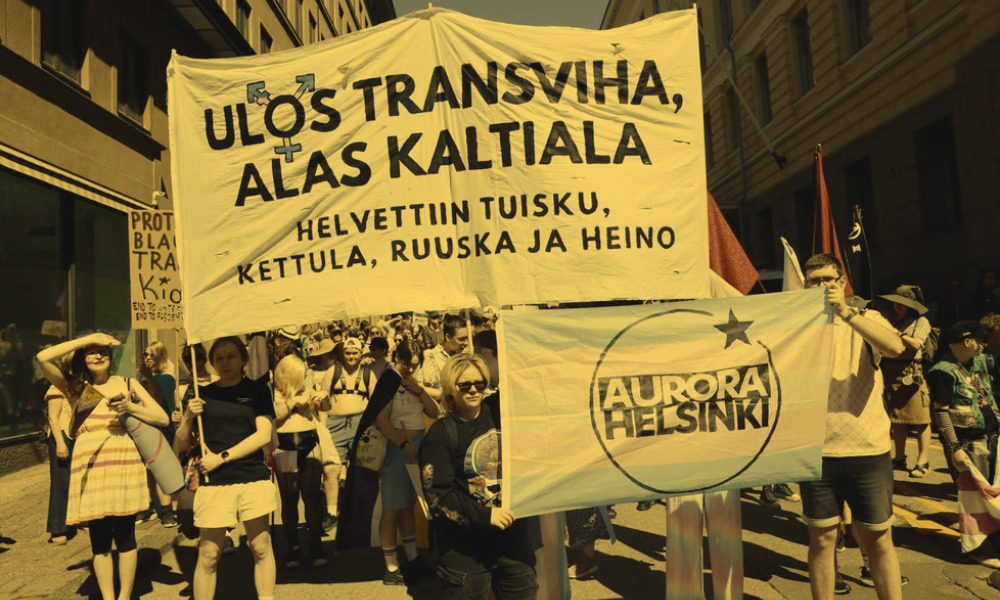
At Helsinki Pride in Finland in June 2026, a block of radical transactivists carried a shocking message: “Trans hate out, down with Kaltiala”. And: “Tuisku, Kettula, Ruuska and Heino must go to hell”. An image of the banner appeared in an otherwise upbeat and cheerful report on the march in Helsingin Sanomat, Finland’s largest newspaper. A door at Helsinki University Hospital was also vandalised with the slogan “Down with trans hate”.
The people targeted by name with such hostility are medical doctors and researchers. What have they done to be subject to such an aggressive display of political emotion?
Inconvenient findings, aggressive responses
Transactivism in Finland has not been as aggressive in its public displays as in some other countries, such as the United Kingdom or Germany. In both countries, academic and professional conferences have been harassed and threatened, sometimes with violent demonstrations: An event of the Clinical Advisory Network on Sex and Gender (CAN-SG) in 2024 in London faced a violent demonstration outside the venue and activists tried to break in. And in 2025 in Berlin, the conference of the Society for Evidence-Based Gender Medicine (SEGM) faced violent threats and the public targeting of participating scientists, as reported in German media. And just this weekend, a joint CAN-SG and SEGM conference in London, was again met by transactivist protesters outside the venue, amid reports of aggressive confrontations.
In Finland, transactivists have organised street protests outside meetings of COHERE (Council for Choices in Health Care in Finland). Slogans such as “Down with Kaltiala” are not new, and demonstrators have gone as far as directly linking suicide to a lack of medical trans treatments. After such events, images of these messages are circulated online by influencers and NGOs, including organisations receiving public funding, where they feed wider narratives that increase pressure on researchers and seek to silence dissent. At the very least, such campaigns inflict reputational damage; at their most menacing, they can be read as threats of further attacks.
COHERE is a government-appointed expert body tasked with issuing evidence-based recommendations on services included in Finland’s public healthcare system. In 2020, Finland became an international frontrunner when COHERE issued guidelines on the treatment of gender dysphoria in minors based on a systematic review of the evidence. These guidelines have since become internationally known as an early move towards a more cautious, evidence-based approach to medical interventions in young people. It shifted the centre of gravity back towards comprehensive assessment, psychiatric care and caution about medical intervention. Unlike the Dutch Protocol, which established a staged pathway from puberty suppression to cross-sex hormones, the Finnish guidelines place psychosocial support and the treatment of co-occurring psychiatric problems first.
The Finnish researchers under attack
Riittakerttu Kaltiala is Professor of Adolescent Psychiatry at the University of Tampere and is globally known for having carried out and led influential research on gender dysphoria in young people. The other names are less widely known medical doctors and researchers who have published research articles in psychiatry together with Kaltiala. Some of them have worked hard to establish respectful dialogue with their critics.
Psychiatrist Dr Katinka Tuisku has been working as Deputy Chief Physician at the Hospital District of Helsinki and Uusimaa region for over 15 years. Psychiatrist Kaisa Kettula worked as Assistant Chief of the Gender Identity Clinic at the Hospital District of Helsinki and Uusimaa (HUS) from 2021–2026, but now works in a different hospital district in Finland that does not have a gender identity clinic. Finland has only two of them, in Helsinki and Tampere. Together with colleagues, Kettula and Tuisku have authored an article on nine Finnish cases of detransition. The article highlights traumatic experiences and psychiatric illness as recurring themes in narratives of detransition.
Sami-Matti Ruuska works as a clinical instructor of adolescent psychiatry at the University of Eastern Finland, as a specialist medical doctor at Kuopio University Hospital, and is pursuing a doctorate at the University of Tampere. Ruuska has been the first author of two peer-reviewed articles that have made headlines on both sides of the Atlantic. The first, in 2024, was a register study on the thankfully low suicide mortality of young people in contact with gender identity clinics in Finland. The second, in 2026, likewise on register data, dealt with psychiatric illness in adolescents and young adults seeking treatment for gender dysphoria. As he is pursuing a doctorate, there are more articles, a doctoral defence, and hopefully future post-doctoral research to look forward to.
Elias Heino works as a general practitioner in private healthcare. He completed a doctorate in medicine on gender dysphoria in young people a couple of years ago. SSome of its findings, such as young people with non-binary identities being involved in bullying and not merely being subject to it, may be difficult for transactivists to process.
Who takes responsibility for aggression and intimidation?
A common defence of the banners naming specific researchers is that, as an event and a demonstration in public space, Helsinki Pride is open to everyone. Anyone can turn up with banners saying almost anything. On the other hand, Helsinki Pride has been strict in setting the parameters for which organisations and groups are accepted as partners and supporters of the event. In 2023, right after the Finnish Parliament approved the new law on legal sex self-ID, Helsinki Pride declined partnerships with the Centre Party and the National Coalition Party (Finnish Conservatives) due to some of their Members of Parliament voting against self-ID.
After the march, a prominent organiser and activist associated with the transactivist block defended the decision to single out the researchers by name. On social media, the activist argued that the doctors had been targeted because of their alleged involvement with what they called “anti-trans hate groups”, including SEGM and Genspect: “All doctors named on the banner act in antitrans hate groups, with their own names and faces. Those who don’t are not named. We didn’t choose the names at random.”
The public naming of individual researchers was not incidental. It was deliberate, and justified by portraying their engagement with organisations that challenge activist claims about gender medicine as participation in “hate groups”.
Helsinki Pride Community, the NGO managing Helsinki Pride, has recently been the subject of media reporting due to alleged inappropriate management and behaviour in the workplace. It has also been in the news for proposing strict non-disclosure agreements for its paid staff, going well beyond the confidentiality obligations normally recognised under Finnish employment law, with heavy fines for potential breaches.
Just days after the Pride march, the Finnish Medical Association, the trade union representing medical doctors, issued a statement on its social media channels defending the maligned doctors and stating that it had contacted Helsinki Pride Community about the matter. If Helsinki Pride were concerned about what the wider public think of its level of professionalism and adherence to evidence-based healthcare for young people with gender dysphoria, it could model and facilitate respectful dialogue between transactivist groups and healthcare professionals.
In recent years, Helsinki Pride and its umbrella organisation have rejected the evidence base concerning treatments for gender dysphoria in young people with the same rejection as large and small LGBT organisations across Europe and the wider Western world. Thus, it can be expected that this angry messaging will continue to be given space for the foreseeable future. Yet malicious and aggressive attacks on serious researchers do more than poison an already fraught debate: they create a climate of intimidation and pose a genuine threat to those whose work produces inconvenient findings. At the same time, they make increasingly visible to the wider public that this brand of transactivism has little interest in engaging with evidence or argument, preferring instead to shout down, malign, and intimidate those who refuse to fall into line. Few things are more likely to pique people’s curiosity than being told that a subject must not be questioned, discussed, or even thought about.