

On 15 May 2026, shortly after taking office in Hungary, the newly elected Prime Minister Péter Magyar began dismantling the political machinery built during the long rule of Viktor Orbán. Fences were taken down literally and metaphorically; public institutions came under scrutiny with images emerging showing political propaganda leaflets stacked inside public bodies expected to remain neutral and independent. Institutions funded by taxpayers and entrusted with public authority had become extensions of Orbán’s ideological control over the Hungarian people.
The long-awaited political change in Hungary was welcomed enthusiastically across European institutions. For years, Brussels criticised Orbán’s system as a warning tale of democratic erosion: the merging of state ideology, public administration, media and judiciary into one political apparatus. European officials repeatedly described Hungary as an example of a political system that undermined EU founding values: democracy, pluralism and rule of law.
Undermining the core principles of the EU was a bad look for the “elective autocracy” of Orbán who did not particularly care about his image in the eyes of EU technocrats. It is however a much worse look for the EU technocrats themselves who now explicitly, regularly and unapologetically use their institutional power to promote ideas and concepts that not only lack a legal basis and have never been scrutinised by EU legislators for their impact on EU citizens, but also appear to lack broad public support.
As this year’s Pride Month approached, IDAHOBIT Day on 17 May was marketed as a particularly grotesque opening ceremony for an entire month of institutionalised ideological campaigning. The official social media accounts of the EU, the Council of Europe and the UN descended into a deluge of activist slogans, emotional affirmations and dogmatic messaging entirely detached from the legal language, institutional mandates and democratic obligations these bodies are supposed to uphold.
The Council of the European Union declared that “every colour shines” and “all rights matter”, including, apparently, rights that have never been codified in EU law. Its Presidency State, Cyprus, dropped all legalities altogether and simply announced that it “stands with love, today and every day”. The European Commission turned to the therapeutic importance of being “seen”, its Directorate for Justice channelled Lord Byron with “love never meant to be muted”, and Commission President Ursula von der Leyen joined the chorus with an appeal to everyone to be their “authentic self”, presumably aimed in particular at stereotype-non-conforming youth, for whom the path to “authenticity” involves cosmetic surgeries, synthetic hormones and irreversible health consequences.
The European Parliament reminded everyone of its inability to distinguish between one’s sexual orientation and one’s confusion about their sex by reiterating its uninterrogated focus on banning “conversion practices”, while its Socialist and Democrats political family celebrated “sexual and gender diversity”- a phrasing more appropriate to a field guide to the reproductive strategies of tropical fish.
The icing on the IDAHO cake was served by the European Court of Justice that weighed in with a legal illiteracy video explainer that calls sex – a major non-discrimination ground in EU law – gender, while treating it as gender identity. That gender identity itself, much like the mysterious “+” at the end of LGBT that the EU court proclaims to defend, has never been defined in EU law appears to present no issue for the highest judiciary body of the EU – an unsurprising detail considering its recent ruling on Hungary that introduced non-legal terms such as “cis-gender” in the jurisprudence of the court.
It is difficult to say with certainty whether this choreographed digital messaging was the result of a top-down coordinated campaign. We can, however, be certain that such an orchestration of collective reverence towards the demands of a small minority of gender identity lobbyists is neither a coincidence nor an expression of genuine concern for the rights of lesbians and gays, many of whom can no longer associate with the meaningless – and often destructive – slogans of the perpetually expanding LGBTQI+ umbrella family.
When EU institutions produce such synchronised display of virtue, it is safe to assume that it was not only approved at a high institutional level, but that the institutions giving that approval – the same bodies supposed to uphold the rule of law, promote pluralism and safeguard the principles of non-discrimination – have become deeply entangled with a highly influential network of activists who operate both within and outside these institutions.
The official theme of IDAHOBIT 2026 was “At the heart of democracy”. This title, engineered by the international IDAHOBIT campaign that includes major LGBTIQ+ activist organisations (ILGA, EL*C, GATE etc.), was transmitted across EU institutions, including its directorates, diplomatic missions and agencies, as well as national authorities, corporations and civil society. And just as “anti-gender” has become a catch-all denunciation of gender heretics – critical academics, gays and lesbians and feminists – the 2026 IDAHOBIT theme, LGBTIQ+ At the Heart of Democracy, has become a timely article of faith in the cathechism complete with rainbow iconography and ritual declarations, and as far removed from actual democracy as liturgy is from legislation.
The crypto-religiosity of IDAHOBIT would not be so farcical if it were a one-off performance after which the EU officials would get on with their actual jobs: assessing how the next EU Multiannual Financial Framework will affect different populations, examining the impact of merged funding streams on sex-based protections for women and girls, grappling with the legal and policy implications of conflating homosexuality with gender identity, or addressing the everyday material concerns that shape citizens’ lives.
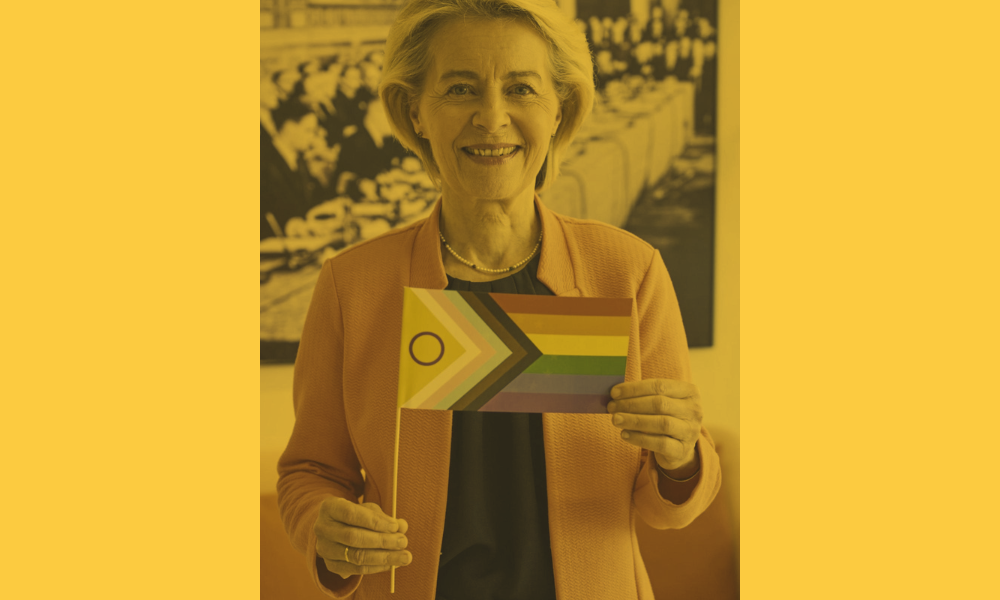
Yet expecting European institutions to return to the business of governance may already be asking too much. IDAHOBIT merely served as the opening act of Pride Month, during which Progress Pride flags replace the European flag on institutional buildings, social media accounts become campaign platforms and transactivist slogans are amplified for weeks on end.
This institutional activism is the product of years of sustained lobbying within European legislative and policy structures, strategic placement of personnel within EU decision-making bodies and the creation of intra-institutional networks and coalitions tasked with promoting gender identity. While many EU officials are concerned by the extent to which advocacy groups have embedded themselves into these structures, most remain silent rather than risking the consequences faced by Roisin Michaux, who lost her job in the Commission after expressing gender-critical views.
The result is the degradation of democratic principles within institutions charged with protecting them, and an environment in which access, influence, legitimacy and power are afforded to a small circle of well-connected advocacy actors operating without any consultation, let alone agreement, with those they proclaim to represent. Whatever else this may be, it bears little resemblance to the “heart of democracy”. Indeed, for institutions that increasingly place democracy at the centre of their messaging, it is difficult to imagine a more undemocratic way of engaging with the public.
European officials spent years warning Viktor Orbán about the fusion of ideology and public administration. Citizens across Europe now have every reason to ask whether Brussels has moved closer to that model than it cares to admit. While the coming years will show whether Péter Magyar delivers on his promise to open institutions to greater scrutiny and public accountability, this challenge extends far beyond Hungary.