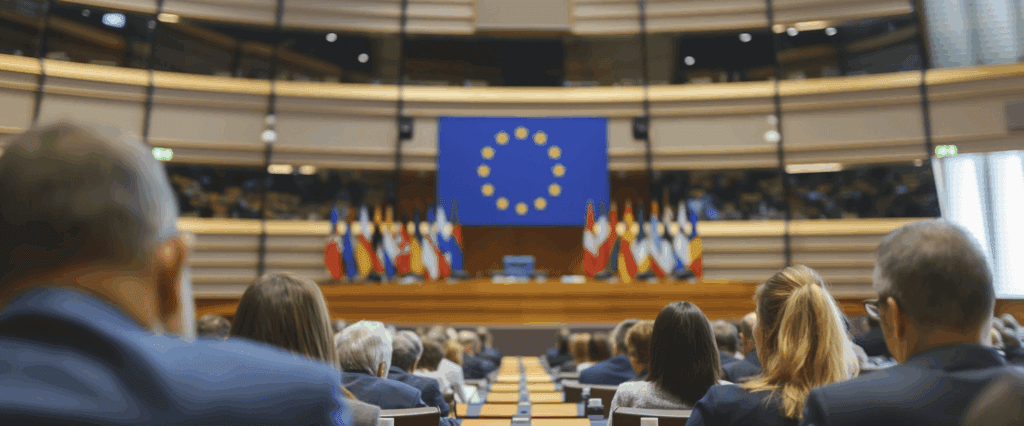
On 12 February 2026, the European Parliament (EP) voted in favour of a recommendation to the Council of the EU on priorities for the 70th session of the UN Commission on the Status of Women (CSW), which will take place in New York in early March 2026. Such votes often pass unnoticed, but this one drew consternation and some confusion on social media, largely because paragraph (y) called on the Council to “emphasise the importance of the full recognition of trans women as women”.
To understand how this came about and what consequences it may have requires some context.
The Commission on the Status of Women and its “conclusions”
The CSW is composed of 45 UN Member States, but its annual session is attended by all 193 Member States of the United Nations, as well as UN agencies and accredited civil society organisations. The main function of the CSW is to measure the advancement of women’s rights globally.
Each annual session of the CSW, which lasts for two weeks, concludes with the adoption of a non-binding document called the “CSW conclusions”, negotiated by all UN Member States. This document outlines collectively agreed commitments on a priority theme relating to women’s rights, with the 2026 priority theme being women’s access to justice.
Before the agreed conclusions take their final shape, a draft of the document is prepared by UN Women, which acts as the secretariat of the CSW. This draft is circulated to all UN Member States, including all EU Member States as well as the EU’s official delegation to the UN, well in advance of the Commission’s session in New York. At this point, Member States begin preparing their positions, formulated as amendments, revisions, proposals and similar contributions to the draft.
It is this position of the European Union that the European Parliament’s recommendation to the EU Council concerns.
The European Parliament’s recommendations
Neither binding on the EU Council as a co-legislating body of the EU, nor binding on individual EU Member States, the document adopted by the European Parliament is, at best, a wish list and, at worst, an instrument of political pressure. Simply put, the EU Council is under no obligation to follow it. Considering the current constellation of conservative states within the UN, as well as the fact that the CSW conclusions have no binding force, one could argue that the European Parliament’s recommendation is simply irrelevant in the larger scheme of things.
However, ignoring European Parliament recommendations would be precisely the kind of oversight that has led to policy capture by gender identity advocates and, eventually, to the deep crisis of democracy we are witnessing in the EU today.
The EU’s position at the CSW carries significant weight, given the financial and political power it wields globally. At the CSW, the EU usually acts as a bloc, and should the European Parliament’s recommendations be taken seriously by the EU Council, this could mean that during the forthcoming negotiations in New York the EU may attempt to advance its “trans women are women” position at the global level.
The EU on the global stage
Instrumental in this process is the EU diplomatic service, the European External Action Service (EEAS), whose ideological capture we covered in our report Beneath the Surface. Well known for its concerted promotion of gender identity on the global stage, the EEAS plays an important role in shaping and facilitating the EU’s position at the CSW. Another actor in this process is the presidency of the EU Council, a role held by Cyprus from January 2026. Civil society actors with access to EU Member States’ governments and diplomatic missions in New York may also play a role in influencing the EU’s final position.
Through complex, behind closed doors negotiations between EU Member States, this position is currently being consolidated. Once a consensus is reached, the EU will have a document containing amendments and proposals to the so-called “CSW zero draft conclusions” that it received from the UN some time ago.
Based on the version of the conclusions seen by Athena Forum two weeks ago, the document had been drafted in typical UN jargon, peppered with phrases incomprehensible to ordinary people and saturated with references to “gender”, such as gender transformative, gender sensitive and gender focused. However, nowhere in the document were the extremist views expressed that the European Parliament recommends.
It is worth remembering that an initial draft of the conclusions may change significantly by the end of the intergovernmental negotiations. The direction of those changes will largely depend on individual UN Member States’ priorities, the pressure exerted by other states, and the cost-benefit analysis each state undertakes during the negotiations.
In practice, this means that states less inclined to become entangled in the political controversy created by gender identity may yield under pressure from states promoting the erasure of sex. It may also mean that the EU’s consensus position, facilitated by Cyprus, will not include any references to “trans women”. What it does not mean is that activists who lobbied European Parliamentarians to include these references in the recommendation to the Council will refrain from using the document to misinform UN Member States, civil society and philanthropists by claiming that this is, in fact, the agreed position of the EU. That is where the main danger of the European Parliament’s recommendation lies.
Political expediency and the cost for women
What transpired in the European Parliament vote on the recommendation was not, in most cases, driven by explicit hostility to women’s rights. There is a broadly shared conviction among many Members of the European Parliament that the Commission on the Status of Women is important and that the European Union should arrive in New York with a strong and visible position. At the level of political messaging and public relations, “doing something for women” commands near-universal support.
The problem is that good intentions fall short when confusion, legal illiteracy and political fear produce deeply flawed outcomes.
As seen elsewhere, including in the recent PACE vote on “conversion practices”, many parliamentarians do not attend the debates and do not read documents attentively. When they do, they often lack a clear understanding of the legal implications and complexities involved. Most troublingly, voting increasingly reflects political expediency, not a desire to defend a specific position, but a desire to avoid being associated with something deemed unacceptable, in this case “fascism”. When powerful transactivist lobbying groups readily deploy such accusations, MEPs vote defensively, making women and children collateral damage in the process.
As often happens with unpopular and controversial clauses in legal documents, the “trans women are women” clause was introduced through an amendment to the original draft of the recommendation. It is entirely plausible that some members of the FEMM Committee that produced the initial draft of the recommendation, including its Spanish socialist chair Lina Gálvez, did not set out with the intention of inserting language that erases women into a document linked to global women’s rights negotiations.
Yet the amendment was accepted by most voting MEPs in the plenary, not only from the socialist S&D and liberal Renew groups, but also from the conservative EPP, whose members either voted in favour or abstained. This demonstrates the rift within the conservatives seen elsewhere in Europe, as many of their members are wary of being associated with positions labelled as far right.
It is also worth remembering that the “trans women” amendment was introduced by Renew MEPs Raquel García Hermida-Van Der Walle (Netherlands) and Lucia Yar (Slovakia). This is the same political family that, during the previous parliamentary term, spearheaded efforts that resulted in the removal of rape- and prostitution-related provisions from the final text of the Directive on combating violence against women. Those who resisted women’s right to protection from sexual violence and exploitation now advance language that risks erasing the legal category of sex on which those rights depend.