


Statistical offices rarely publish detailed data on medical transition procedures. Without official figures, the public is left largely with reassurances from activist organisations: that these interventions are rare, that they follow careful deliberation, and that they are never performed on minors. But without reliable data, such claims cannot be independently tested or meaningfully questioned.
Germany is an exception. Its Federal Statistical Office publishes detailed hospital statistics on individual medical procedures, broken down by sex, age group and the patient’s place of residence (by federal state, or abroad). The source is the DRG-Fallpauschalenstatistik (DRG statistics, from “Diagnosis Related Groups”), based on the system through which German hospitals are reimbursed for inpatient treatment. Individual procedures are recorded using specific codes from the official German Operationen- und Prozedurenschlüssel (OPS), allowing particular types of medical intervention to be identified in the data. Put simply, the statistics provide an unusually detailed picture of procedures performed on hospital inpatients in Germany.
The hospital statistics assign a specific code to what they classify as “genital sex reassignment surgery” (OPS 5-646). The category includes procedures such as orchiectomy, penectomy and vaginoplasty for male patients, and hysterectomy and the construction of a phallus (phalloplasty) for female patients. Importantly, these operations result in sterility.
The data have limits. They do not include mastectomies or hormone treatment. They also count procedures, not patients: where treatment involves several separate operations, the number of individuals undergoing surgery will therefore be lower than the number of procedures recorded.
On the other hand, genital surgery is usually seen as the last step of medical transition. Many more people will therefore have gone through earlier stages, such as hormone treatment, or undergone other surgical interventions.
There is another limitation: the sex breakdown in the statistics is not reliable. German law allows a person’s legal sex to differ from their biological sex, and the data do not establish which of the two hospitals record in individual cases. There are indications that the recorded category does not consistently represent biological sex. Hysterectomies outside the context of transition, for example, have their own code (OPS 5-683), yet the statistics include patients recorded as “male” under this code. For this reason, this article does not report sex-specific figures.
But crucially, even with these limitations, the data offer a rare insight into a field whose scale has long remained unclear.
Patient profile: many more, and much younger
In 2005, 150 genital surgeries were performed in Germany. In 2025, there were 4,184. Since 2005, a total of 32,417 genital surgeries have been carried out.
Figure 1 shows how the evolution of these numbers over the past 20 years. The left panel shows the incidence per 100,000 people in each age group. This measure is important because it lets us compare age groups of different sizes: For instance, ten procedures among minors weigh more than twenty among people over 65, because the older group is much larger. The right panel shows the absolute number of surgeries.
Figure 1 shows the evolution of these numbers over the past 20 years. The left panel shows the incidence per 100,000 people in each age group. This measure is important because it allows us to compare age groups of different sizes. For instance, ten procedures among minors weigh more than twenty among people over 65, because the older age group is much larger. The right panel shows the absolute number of surgeries.
Measured by incidence, the data show that since about 2015, genital surgery has been most common among 18- to 25-year-olds, followed closely by 25- to 35-year-olds. In 2025, there were more than 20 genital surgeries for every 100,000 people aged 18 to 25.
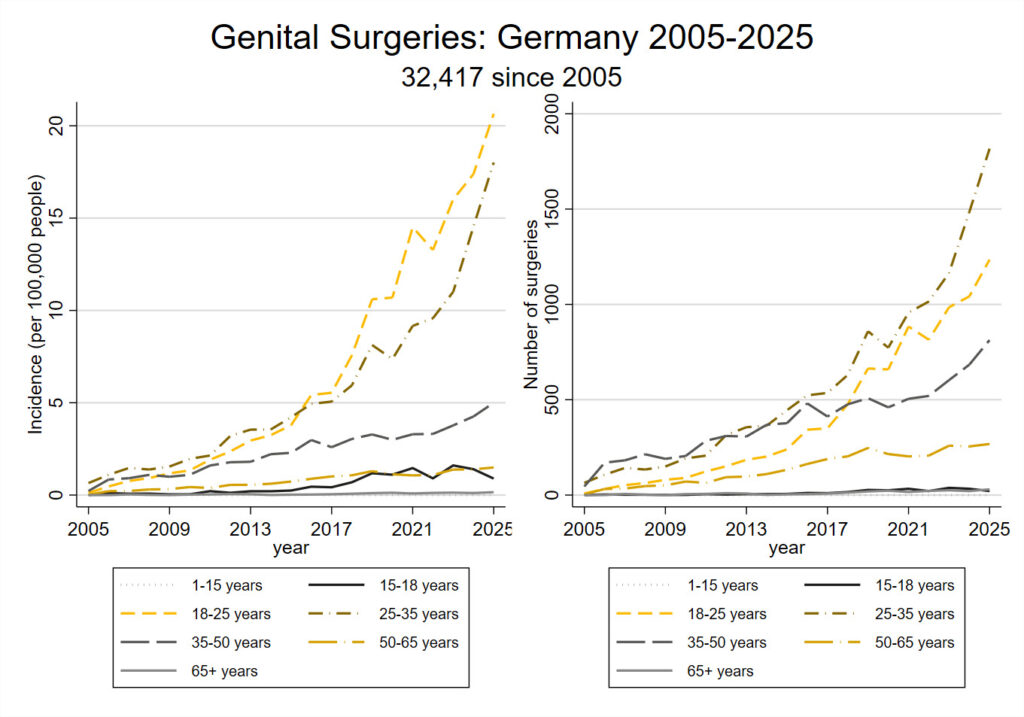
Figure 1: Genital surgeries by age group: incidence per 100,000 and absolute numbers. Source: Federal Statistical Office of Germany, DRG-Fallpauschalenstatistik and Fortschreibung des Bevölkerungsstandes; own calculations
The age distribution in Figure 2 shows the same pattern. In 2005, genital surgeries were rare across all age groups. Over the following years, their number rose sharply, and they are now concentrated in younger age groups.
It is important to put these numbers into context. These are highly invasive operations. For male patients, the male genitalia are removed and a cavity intended to resemble a vagina is created. For female patients, the uterus is removed and a neo-phallus is constructed.
Complications are common. A 2025 systematic review and meta-analysis published in The Journal of Sexual Medicine found that, among male patients who had undergone vaginoplasty, up to 15% experienced urinary incontinence, up to 20% experienced urinary irritative symptoms, and 25–75% reported sexual dysfunction. Among female patients who had undergone hysterectomy and phalloplasty, up to 50% experienced urinary incontinence, up to 37% experienced urinary irritative symptoms, and 54% reported sexual dysfunction. The authors note significant statistical heterogeneity across the studies included in the analysis.
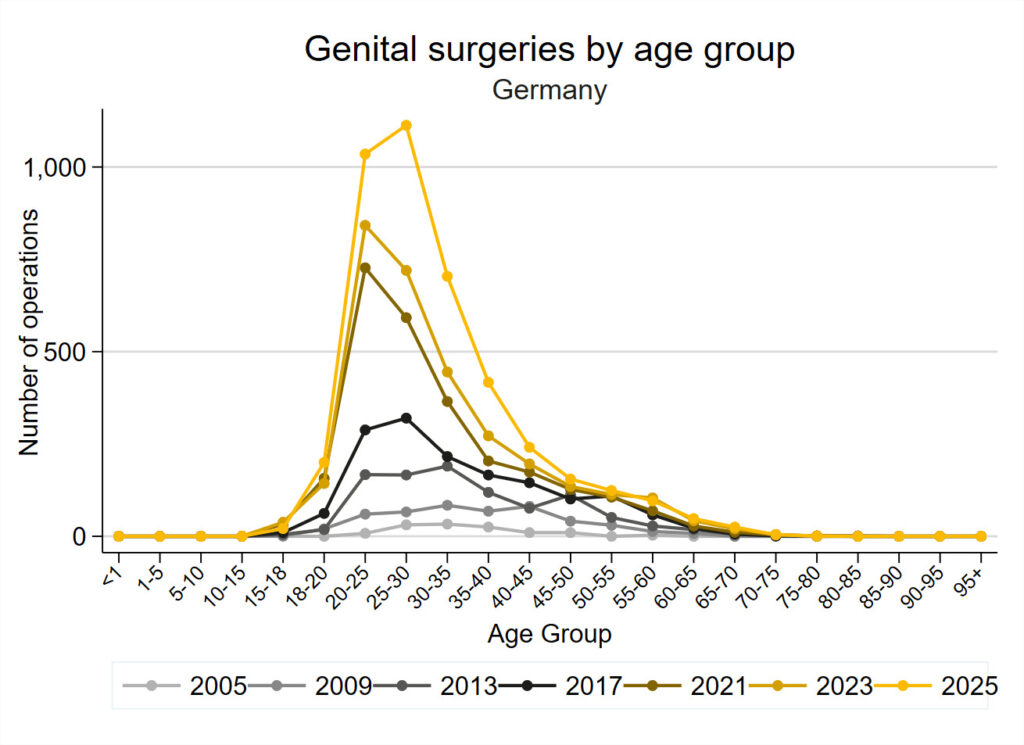
Figure 2: Age distribution of genital surgeries. Source: Federal Statistical Office of Germany, DRG-Fallpauschalenstatistik
Both figures also show something more subtle and disturbing: these operations are performed on minors as well, though in much smaller numbers. The solid blue line in Figure 1 shows that incidence in this age group has been rising since the early 2010s.
This raises an important legal question. Section 1631c of the German Civil Code explicitly prohibits consent to the sterilisation of a child: neither the parents nor the child themselves can consent to it.
The issue of minors: are German clinics breaking the law?
Figure 3 shows the development of genital surgeries recorded for minors. In 2005, no such procedure was recorded. By 2023, the number had risen to 38, before falling to 21 in 2025. In total, 272 genital surgery procedures have been recorded for minors since 2005.
Since genital surgery is usually the final stage of medical transition, far more minors have probably been treated with puberty blockers and cross-sex hormones.
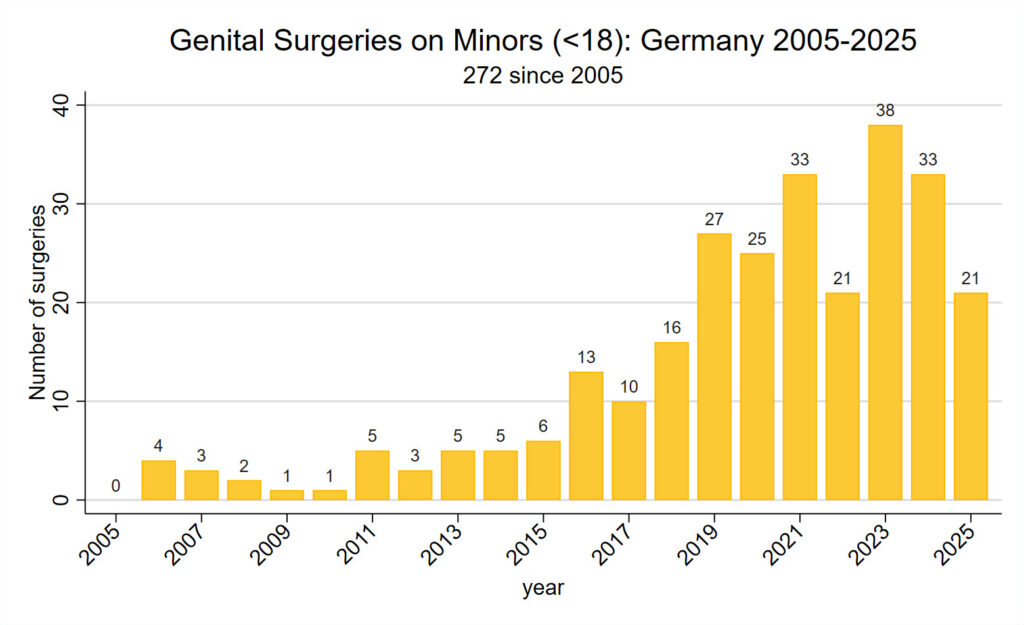
Figure 3: Genital surgeries on minors. Source: Federal Statistical Office of Germany, DRG-Fallpauschalenstatistik
This raises an obvious legal question: how can these operations be performed on minors when German law explicitly prohibits the sterilisation of children?
Why these operations take place anyway is unclear. One argument often put forward is suicide prevention. However, robust evidence that these interventions prevent suicide is lacking. Sex Matters has published a detailed summary of the evidence and the problems with claims that medical transition is necessary to prevent suicide.
In addition, a large share of adolescents referred to gender clinics show signs of same-sex attraction, as Transgender Trend has documented. This raises a further concern, given the history of medicalising same-sex attraction.
Beyond Germany’s borders
These numbers point to a well-established system of gender medicine, with implications beyond Germany itself. Germany is Europe’s most populous country and its largest economy, and its healthcare spending per capita is among the highest in Europe. EU rules also provide a framework for patients to access healthcare across national borders, subject to conditions including national rules on authorisation and reimbursement.
Given Germany’s size, resources and healthcare infrastructure, the country could therefore become an important destination for gender-related medical procedures.
Since 2005, 597 genital operations have been performed in Germany on patients living abroad, five of them minors. These numbers are small, but they have been rising in recent years. If other European countries continue to restrict paediatric gender medicine, cross-border treatment in Germany may increase further.
Germany’s data offer a rare view of how medical transition has changed over the past two decades: a dramatic increase in genital surgeries, a pronounced shift towards younger patients, and procedures performed on minors. These developments raise medical, ethical and legal questions. Whatever conclusions one draws from the data, the debate can no longer proceed as if the numbers did not exist.