

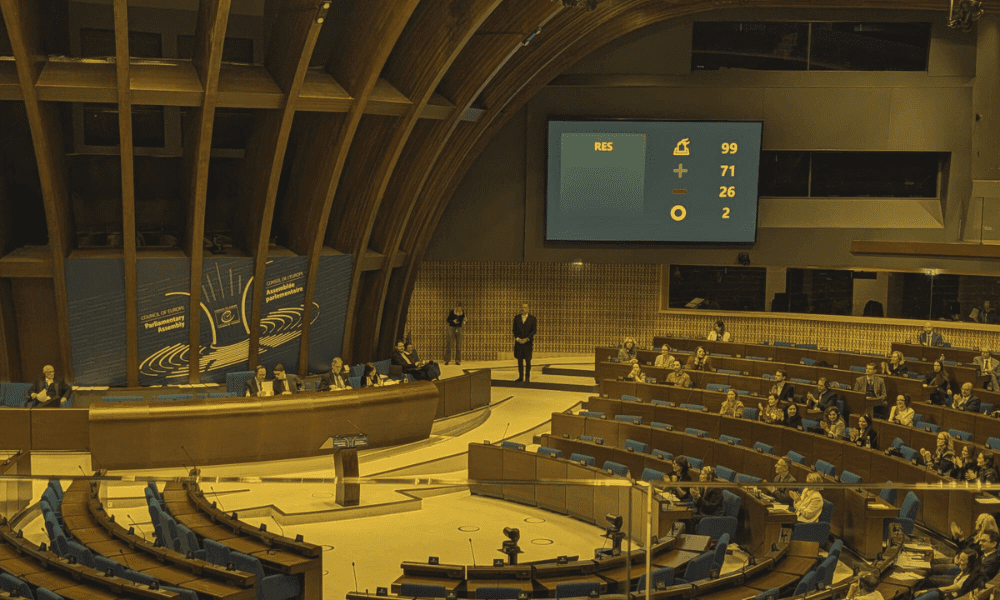
In their first session of 2026, the Parliamentary Assembly of the Council of Europe (PACE) debated and adopted a resolution on banning so-called “conversion practices” – the newer, broader term for conversion therapy – proposed by UK Labour MP Kate Osborne. PACE resolutions are formally non-binding, but they carry significant normative and political weight. They are routinely cited by governments, courts, international organisations and advocacy groups as evidence of a “European consensus”.
A manufactured consensus
The debate was marked by chronically low attendance. Less than one third of 306 PACE members (national MPs from the Council of Europe‘s 46 member countries) were present, many of them substitutes rather than full members.
This level of attendance reflects both the ongoing institutional dysfunction of the Assembly, where debates are routinely conducted before nearly empty chambers, and strategic avoidance of a politically contentious subject with foreseeable legal and social consequences.
This absence reflected particularly badly on members of the conservative group of the European People’s Party and Christian Democrats (EPP/CD), who claim to stand for the “European values” of subsidiarity, pluralism and the rule of law. These concepts carry little weight when those who claim to defend them do not attend a debate concerning a resolution with wide-ranging implications at national level.
The debate itself was driven by a very small group of British Labour MPs, already known in the UK for their support of policies that erase sex and undermine the rights of lesbians and gays, which, ironically, many of the UK speakers identified as.
Moral Panic in place of evidence
The debate relied heavily, on one side, on hyperbolic claims from activist MPs asserting that “one in three LGBTIQ persons” in Europe are subjected to conversion practices amounting to torture, with the most affected being “transgender individuals.” This contention is derived from a methodologically bankrupt report from the FRA, the European Union‘s Agency for Fundamental Rights, where “gender identity” is indistinguishable from sexual orientation. The report lumps together fundamentally different phenomena – violent crimes, including sexual and domestic violence, family conflict, religious disagreement and legitimate healthcare – and counts them as “conversion practices,” artificially inflating prevalence figures and distorting the issue.
On the other side, the debate was marked by deferential acceptance of these claims, as well as public expressions of allegiance by most political groups across the Assembly, including self-proclaimed conservatives the EPP/CD who cravenly thanked the rapporteur for agreeing to their token amendment which did nothing to ameliorate the harms contained in the resolution. Only one EPP/CD member spoke against the resolution along with members of the right wing European Conservatives, Patriots & Affiliates group (ECPA).
To no one’s surprise, the keynote defence of the resolution was delivered by Helena Dalli, former EU Commissioner for Equality, best remembered in the EU institutions for her attempt, in 2021, to “cancel Christmas” through her later withdrawn guidance on “inclusive language”. Prior to that, Ms Dalli oversaw the dismantling of sex-based protection of women in Malta, the removal of references to mothers and fathers from birth certificates, and the introduction of gender identity into the Maltese constitution. In the PACE hemicycle, she delivered a passionate and defensive intervention, centred on the claim that transgender children urgently require protection from malicious actors who could in any way doubt these children are, in fact, of the opposite sex.
Human dignity as a shield
A recurring thread throughout the debate was the invocation of human dignity – a concept that occupies a specific place in international law: it functions as the foundational source of human rights, an inherent and inviolable attribute that cannot be impinged upon, open to limitations, or overridden by other rights. Whereas other rights can be balanced, human dignity cannot.
Once contested, unverifiable and politically polarising concepts of gender identity and gender expression are placed under the umbrella of human dignity, they become legally insulated. By framing claims around gender identity and conversion practices as matters of human dignity – reinforced by repeated references to torture which sits squarely within the human dignity framework – the activists in the Assembly attempted to construct a legally sealed argument, thus pre-empting potential scrutiny across other domains: therapeutic practice, freedom of expression, parental responsibility, professional autonomy and safeguarding, among others.
This strategy proved effective: most potential opposition, particularly among conservatives, was neutralised at the outset. They did not question the resolution. They affirmed it.
The fiction of intent
Another core argument in the debate concerned intent. In response to criticism that the proposed ban would restrict exploratory therapy, activists in the chamber argued that the prohibition would apply only where there was an intent to cause harm. Naturally, once gender identity had already been inscribed as an inviolable aspect of human dignity, intent to harm became inherent. As long as, in the words of the resolution, there was an attempt to change a person’s gender identity, intent was presumed. Questioning, exploration or professional assessment became sufficient to establish it.
If the resolution already appeared beyond repair, the EPP/CD group nonetheless succeeded in making it worse. In a naïve attempt to mitigate the ban’s impact on the independence of healthcare professionals and the role that parents play in supporting children, the group negotiated with the rapporteur an amendment that was ultimately adopted. That amendment embedded into the resolution the formulation that interventions are permissible “so long as they do not attempt to change, repress or suppress” [a person’s gender identity] – thereby reinforcing, rather than limiting, the original prohibition.
The reasoning behind the EPP/CD leadership’s decision is unclear. Did they believe that activist MPs who had been pushing for this resolution for two years had actually conceded a substantive point? Or do they agree that a child’s self-declared gender identity is an unquestionable truth? It’s reasonable to suppose that the rationale was largely strategic; negotiating a token amendment which could be held up to their conservative constituents as having put up a fight, while, at the same time, avoiding uncomfortable accusations of transphobia from activists. Engaging in a meaningful debate with their Socialist opponents, let alone leading one, proved beyond them.
All other amendments that sought to substantively reformulate the text – by separating sexual orientation from gender identity, narrowing the scope of prohibited interventions, or clarifying the definition of conversion practices – were enthusiastically rejected by some 70 of the mere 99 MPs present in the chamber, confirming their allegiance to the new doctrine of gender identity rather than to sex-based protection of rights, legal reasoning, scientific evidence, or rule of law.
Defaming the opposition
Alongside the arguments above ran a familiar strategy of delegitimising opposition. Any criticism of the ban was described by intervening MPs as “misinformation” and as a coordinated attack. Lesbian, gay and feminist activists, child-rights experts and clinicians opposing the resolution were collectively dismissed as well-funded reactionary forces, folded into a single boogeyman of homophobic and transphobic actors poised to harm an imagined, ever-expanding “LGBTQI community”.
The vote did not deliver the outcome we sought, but it was the outcome we anticipated. The campaign undertaken by Athena Forum – run entirely by volunteers on a shoestring – was taken up by grassroots initiatives across Europe who translated our brief and emailed their own national MPs, with the result that more than 15,000 emails were sent to PACE members. The effort devoted to dismissing and discrediting any opposition to this resolution during the debate suggests the message was heard.
No time for complacency
The debate in the PACE hemicycle offered a revealing glimpse into the current condition of European and international institutions. Low attendance, weak scrutiny, legal illiteracy, fear-driven voting, and the ease with which ideological assertions override reasoning characterised the proceedings. For many years, supranational fora like the Council of Europe have been used to advance gender identity-related agendas. Many of these policies have not been democratically debated or even sufficiently supported, yet ultimately undermine the rights of women, lesbians and gays and vulnerable children.
What unfolded in the Parliamentary Assembly of the Council of Europe was history repeated. Unless our MPs treat international fora with the seriousness and competence they deserve, we will continue to witness the same mistakes. The next step we can already anticipate will not be a non-binding resolution, but the inscription of a conversion practices ban into the EU constitution – a demand currently on the table at the European Commission.